Gene therapy needs a way to control how much protein is made and for how long. Current inducible systems are often large, work only briefly in vivo, or depend on regulator proteins that can provoke immune responses.
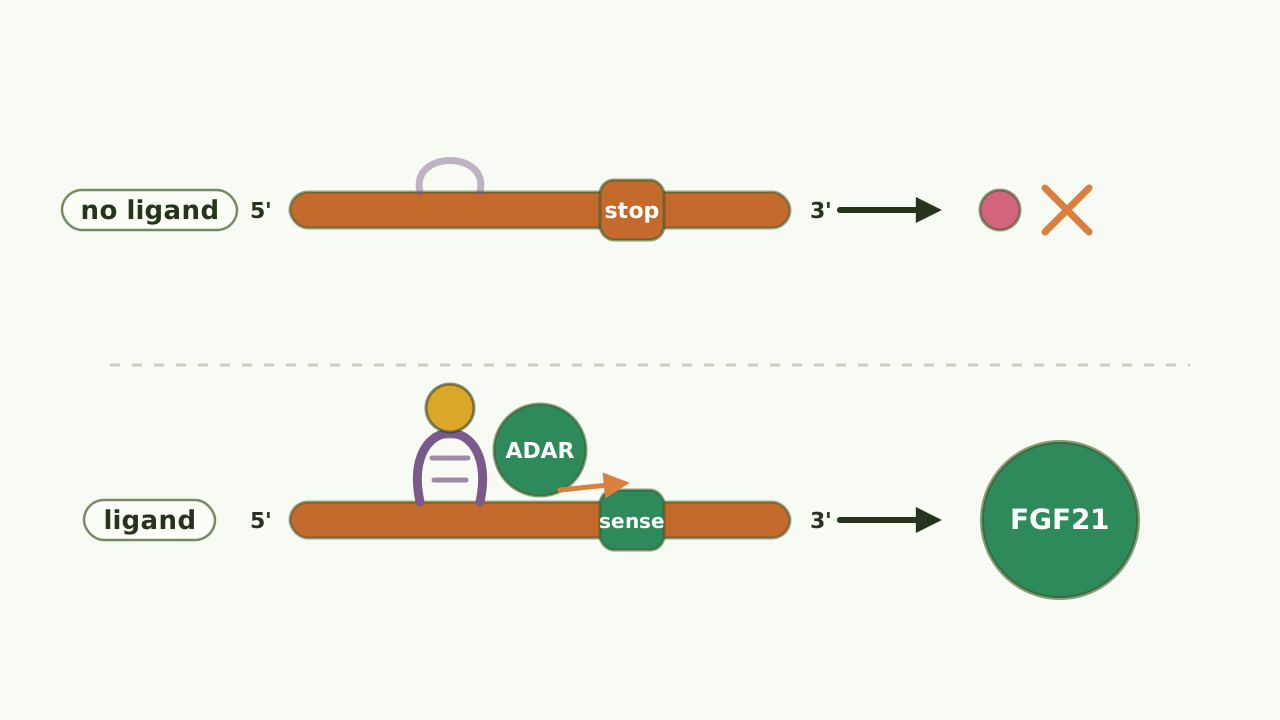
What they did. The authors built the adaptamer, an ADAR-modulatable aptamer. It is a compact RNA switch of fewer than 120 base pairs that pairs an aptamer responsive to FDA-approved small molecules with ADAR, an RNA-editing enzyme the cell already makes. Without the drug, a stop codon blocks translation. When the ligand binds, the RNA forms a double-stranded structure that recruits ADAR, which converts the stop codon into a sense codon and allows the downstream protein to be made.
What they found. The switch worked across multiple cell lines, including human T cells. In mice, an adeno-associated virus (AAV) carrying an adaptamer-controlled gene for FGF21 produced metabolic remodeling that reversed obesity and hepatic steatosis. The mechanism needs no exogenous protein machinery and does not cut DNA or RNA.
Why it matters. A small, drug-responsive switch built from components that are already in cells could make genetic medicines easier to dose and to turn off, which matters for proteins such as FGF21 that are potent and dose-limited.
Keep in mind. This summary is based on the abstract; the full text was not reviewed, so the abstract's numbers on dose, timing and effect size are not reproduced here. The data are from cultured cells and mice, and the abstract reports no human data. Whether the system stays safe and controllable in people is not addressed.
- Paper
- Bryant J, Herron L, Doctor Y, et al. Regulatable in vivo gene expression via adaptamers. Molecular Cell. Published online October 20, 2026.
- Type
- Preclinical laboratory study (cells and mice)
- Basis
- Abstract; full text not reviewed
- DOI
- 10.1016/j.molcel.2026.09.037
- PubMed
- PMID 42901161
This brief summarizes a published paper for general information. It is not medical advice.
Related articles
 Daily brief · Oct 20, 2026Programmable Cas13b Silences Cancer-Driving Fusion Transcripts, Including Drug-Resistant BCR::ABL1, in Cell Models
 Science news · Oct 20, 2026Nobel Prize in Physiology or Medicine 2026 Honors the Light-Gated Channels Behind Optogenetics
 Daily brief · Oct 19, 2026A New Class of Mitochondria-Targeted Compounds Induces Ferroptosis and Suppresses Tumors in Cancer Models
Research focus: Molecular Oncology and Cancer Metabolism
Department of Molecular Diagnostics, Faculty of Biomedical Sciences, University of Benghazi, Libya
Weekly digest
The week's briefs and science news in one email. See the privacy policy.
Comments
No account needed. Comments are reviewed before they appear. Please be respectful and on topic.